
Capybara Guide: The Real Animal Behind the Viral Chill Meme
September 16, 2026Capybaras Are Not Beginner Pets: A Reality-Based Guide to Ownership, Cost, and Care
Introduction
Somewhere on your feed, a capybara sits in a hot spring while a bird grooms its fur, and the comments call it the most relaxed animal alive. That clip is real, but it is a sliver of the story. The animal behind the meme is a semi-aquatic rodent that can top 100 pounds (it spends significant time in water but also lives on land), not a mascot.
| KEY TAKEAWAYS• Capybaras are the largest living rodents, native to South America, and are semi-aquatic herd animals that require daily water access and social companionship to thrive.• Capybara ownership is legal in some U.S. states with permits, but illegal or heavily restricted in others; local ordinances often override state law, so verification is essential.• The true cost of capybara ownership extends far beyond the purchase price: expect significant ongoing expenses for space, water features, diet, veterinary care, and companionship.• Capybaras are not beginner pets. They require specialized exotic animal veterinary care, a large outdoor enclosure with a pool, and at least one other capybara companion.• Understanding capybara behavior, predators, and lookalikes deepens your appreciation whether you ever own one or not. |
This guide bridges affection and understanding. It is complete, reality-based, and refuses both viral romanticism and dry encyclopedic recitation. The capybara (Hydrochoerus hydrochaeris) belongs to the family Caviidae, alongside guinea pigs and cavies, and is the largest living rodent. Adults weigh 60 to 174 pounds and measure 3.2 to 4.2 feet, depending on sex.Standing in a rescue pen, watching a 150-pound female refuse to step toward the pool without her herdmate, I stopped treating capybaras as meme material and started learning what they actually are.
What Is a Capybara? Facts, Behavior, and Conservation
The introduction promised reality over romance, so let’s start with exactly what animal we’re talking about. The capybara (Hydrochoerus hydrochaeris) is the largest living rodent, a member of the family Caviidae alongside guinea pigs and cavies.
Two species exist: the greater capybara and the lesser capybara (Hydrochoerus isthmius), which tends to run smaller. An adult greater capybara weighs 60 to 174 pounds and measures 3.2 to 4.2 feet from nose to rump, depending on sex. Not a giant guinea pig.
A semi-aquatic rodent with its own set of demands.
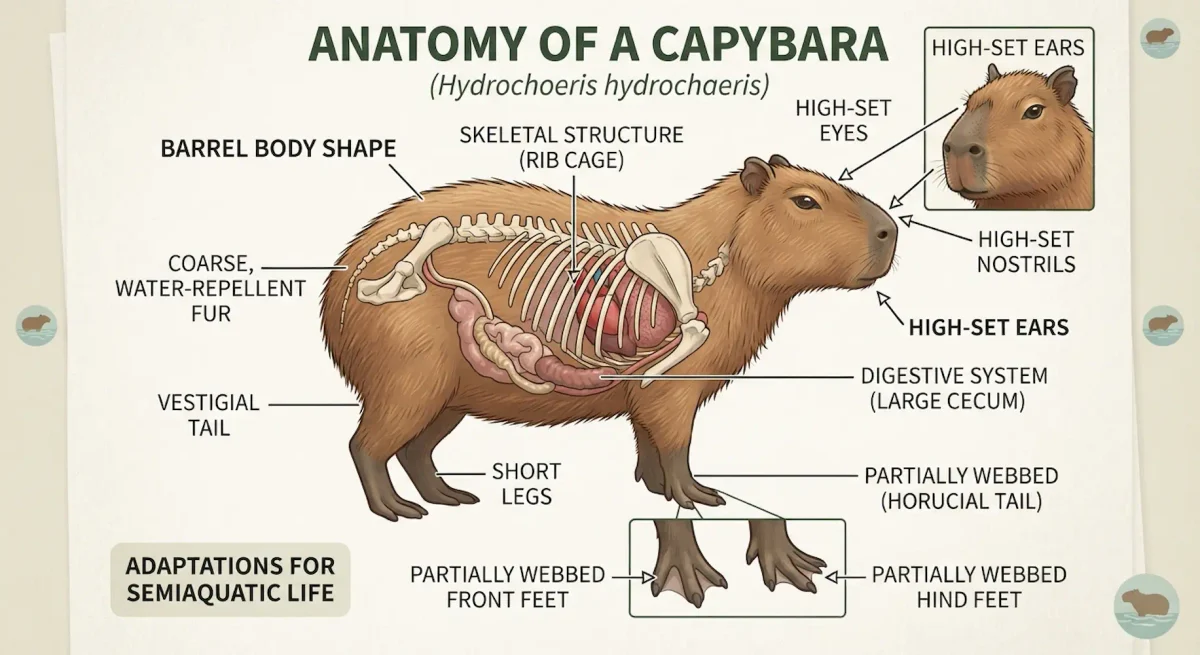
That barrel body is built for water. Capybaras are semi-aquatic, meaning they spend significant time in water but also live on land, and their high-set eyes, nostrils, and ears let them see and breathe while mostly submerged. The appetite matches the body: an adult eats 6 to 8 pounds of grass every day, a fibrous diet that demands a specialized digestive strategy.
Behavior and Social Structure
Understanding the capybara’s social world starts with the full scope of capybara facts and behavior, from group dynamics to daily rhythms.
Capybaras are an obligate social species: they require same-species companionship to thrive. In the wild they live in groups of about ten individuals with a complex social structure, typically led by a dominant male. Their vocal repertoire runs from barks and whistles to purrs and clicks. They’re also crepuscular, meaning most active at dawn and dusk. Mud wallowing is part of the routine, coating the skin and helping regulate temperature and deter parasites.
Isolation is profoundly stressful for an animal wired for constant group contact.
The social wiring is only half the digestive story. Grass is tough to break down, so the capybara practices coprophagy: it produces soft, nutrient-rich pellets called cecotropes and re-ingests them to extract maximum nutrition on the second pass through the gut.
| EXPERT TIPCapybaras re-ingest soft cecotropes to extract maximum nutrition from their fibrous grass diet. This is normal, essential digestion, never a problem to correct. |
The capybara’s most important daily habit is also the one that shatters the romantic image fastest. A neighbor who kept a pair invited me over to see the new enclosure, and about twenty minutes in, one of them hunched over, produced a soft green pellet, then turned and ate it. My neighbor froze and asked if something was wrong with the diet. Nothing was wrong. That pellet was a cecotrope, and the animal was doing exactly what its daily six to eight pounds of grass demands: running the fiber through its gut twice. The neighbor had read the care sheets and watched the videos, and still wasn’t ready for that moment. It’s the gap between knowing an animal in theory and living with its actual biology.
That gap between theory and biology shapes everything about how capybaras behave in the wild, and it’s where conservation reality sets in.
Conservation Status and Threats
The capybara is listed as Least Concern on the IUCN Red List, with a stable population trend as of the 2016 assessment. That status can make the species sound untroubled. It hides real pressures.
Habitat loss shrinks the wetlands and grasslands capybaras depend on. Hunting for meat and leather takes a steady toll across much of the range.Human-wildlife conflict flares where capybaras graze on crops, and in Venezuela and Colombia the animals are farmed for meat and hide, a practice distinct from pet ownership.
Identification is the next practical question, and it matters more than most people expect. A surprising number of “capybara” sightings are actually nutrias or other lookalikes, and the differences are concrete enough to learn.
capybara facts and behavior Deeper coverage of capybara biology, behavior, and conservation.
Capybara Identification: Telling Capybaras Apart from Lookalikes
Knowing what a capybara is only helps if you can recognize one, and the nutria is the animal most often mistaken for it. The fastest field mark is sheer size: an adult capybara runs 60 to 174 pounds and 3.2 to 4.2 feet long, while a nutria tops out near 15 to 20 pounds and about 2 feet.
Ever mistaken a nutria for a baby capybara? I have seen that mix-up repeat at refuges and in ID threads often enough to spot the pattern: someone who knows capybaras only from photos expects a dog-sized animal, then calls a fifteen-pound coypu a “young capybara.” A nutria tops out near twenty pounds and two feet; an adult capybara can pass a hundred pounds and stretch past three feet. Size settles it before the tail even matters.
That size gap is the first check when telling capybaras and nutria apart, and it settles most sightings before anything else.The lesser capybara (Hydrochoerus isthmius) runs smaller, so a modest-sized animal is not automatically a nutria. Range helps too: nutria are invasive across at least 17 to 20 U.S. states, so a semi-aquatic rodent in a southern marsh is far more likely a coypu than a capybara.
| Feature | Capybara | Nutria (Coypu) |
| Adult weight | 60–174 lb | 15–20 lb |
| Body length | 3.2–4.2 ft | about 2 ft |
| Tail | Virtually no visible tail | Long, round, rat-like tail |
| Muzzle | Broad, blunt, squarish | More pointed, prominent orange incisors |
| Feet | Partially webbed | Webbed hind feet |
| Native range | South America | South America (invasive in the U.S.) |
| Conservation status | Least Concern | Least Concern globally; invasive across 17–20 U.S. states |
Tail, muzzle, and foot details vary by individual and region, so confirm against a current field guide for your area.
Identification matters in the wild too, where a capybara’s survival depends on recognizing and escaping the predators that hunt it.
Capybaras in the Wild: Predators and Survival
A capybara’s calm is a survival strategy, honed against a long list of predators.
Jaguars and pumas stalk from cover, ocelots take younger animals, and in the water capybaras and anacondas play out a predator-prey dynamic where the snake strikes from below. Caimans hunt the same shallows. Harpy eagles can snatch a juvenile from the bank.
Living in groups of about 10 individuals is the first defense.
More eyes scanning, more ears catching the snap of a twig, and an alarm bark that sends the whole herd moving at once. Ten capybaras grazed at the pond’s edge, and in three years of watching that same herd I learned to read the exact moment one head lifted: every other head followed within a second, and the whole group had already shifted toward deeper water before I even saw what had startled them. That vigilance is why a lone capybara is a dead capybara.
When danger hits, capybaras do not fight. They run for water, where a semi-aquatic rodent holds every advantage. Submerging with only nostrils and eyes above the surface, or vanishing entirely for minutes, buys time. The retreat works often enough that it shapes their whole daily rhythm: graze near the bank, never far from an escape route.
The Viral Myth Problem
Those viral images of a calm capybara sitting beside a caiman or crocodile are real, but they capture something specific: captivity, habituation, or a predator that has already eaten. In the wild, capybaras and crocodiles do not share a sunbathing spot.
A hungry caiman will take a capybara, and a healthy capybara will not offer itself. The calm in those videos is the exception that proves the rule: these animals read each other constantly, and the distance between them is information.
Predators are one extreme of capybara reality. To see how these encounters play out in the water, check out our breakdowns on capybaras and anacondas as well as capybaras and crocodiles. The next section turns to a rare genetic extreme: the albino capybara.
Rare Capybara Variants: The Albino Capybara
From the everyday dangers of the wild to a rare genetic twist that makes survival even harder.
Albinism is the total loss of melanin, the pigment that colors skin, fur, and eyes. Leucism is a partial loss, leaving some pigment behind. So an albino capybara is white with pink eyes, while a leucistic one may be patchy or pale but keeps normal eye color.
The genetics follow a simple recessive pattern. Both parents must carry the gene for an albino offspring to appear, and a carrier parent looks completely normal. That is why the trait can hide for generations, then surface without warning.
Why is albinism so rare in wild capybaras? Camouflage disappears. A white capybara against green riverbanks and brown water is a beacon to jaguars and caimans. Sun sensitivity is brutal: without melanin, skin burns and eyes strain in open sunlight. Vision is often poor too, which matters for an animal that survives by spotting predators early and diving for safety.
In captivity, albino capybaras need more than standard care. Sun protection becomes essential: shade structures, limited midday exposure, and regular checks for skin damage. Health monitoring matters as well, since albinism can come with eye issues that require specialized veterinary care.
The albino capybara at the facility I worked at needed its shade cloth repositioned three times a day, and that schedule was the moment my mental model cracked. I had filed albinism under “color difference” and moved on. The daily routine said otherwise. Weekly skin checks, an eye exam calendar that never let up, and a shade rotation that followed the sun across the enclosure. None of it was optional, and all of it was invisible in the photos that made albino capybaras look like a simple white variant.
Whether a capybara is albino or not, the biggest question most readers arrive with is practical: can I legally own one?
Capybara Ownership: The Legal Landscape
Before any budget or enclosure, the first gate is the law. It’s a patchwork, not a single answer. No single federal law governs capybara ownership. What’s legal in one county can be a misdemeanor in the next, because state law, county ordinances, city zoning, and HOA covenants each stack their own rules.
The table below is a screening tool, not legal advice. Confirm current rules with state and local agencies before acting.
| State | Legal Status | Permit Required | Key Notes |
| California | Prohibited | No | State ban in place |
| Florida | Legal with permit | Yes | FWC Captive Wildlife License |
| Georgia | Prohibited | No | State ban in place |
| Hawaii | Prohibited | No | State ban in place |
| New York | Varies by locality | Varies | NYC bans by name |
| Texas | Legal | No (state level) | No state permit required |
| Oregon | Legal with permit | Yes | Exotic animal permit |
Local ordinances can override state permission, so verification has to happen at every level before you assume ownership is legal. Florida capybara laws center on the FWC Captive Wildlife License, one of the better-documented permit paths, while owning a capybara in Oregon means working through that state’s exotic animal permit. Navigating both alongside federal rules is detailed further in our guide to the legal side of capybara ownership.. The legal side of capybara ownership gets more concrete once you move from the state map to the actual application.
State permission is only one layer. Last spring, my neighbor two doors down bought a young capybara in Texas, where no state permit is required, then moved to Oregon for work. She assumed the move changed nothing.
Oregon’s exotic animal permit process caught her mid-unpacking, and the capybara spent a month in a licensed facility while she scrambled for paperwork. That gap cost her more than the animal did.
County zoning and her new HOA each had their own say, and neither cared what Texas allowed. That gap is why I tell every prospective owner to start with the permit process, not the purchase.
The Permit Process
A typical permit application involves facility inspection, proof of experience, a veterinary care plan, escape prevention, liability insurance, and sourcing from a USDA-licensed breeder. Even a completed application is only the start, because local ordinances can still override state permission.
| EXPERT TIPBefore spending money on a capybara, call your state wildlife agency, county animal control, city zoning office, and HOA (if applicable), and get every approval in writing. Verbal assurances are worthless when an animal control officer shows up. |
Legal permission is only the first cost. What comes next is the financial reality most people never see coming.
Florida capybara laws covers this in more depth.
owning a capybara in Oregon covers this in more depth.
The legal side of capybara ownership covers this in more depth.
The True Cost of Capybara Ownership
Legality is the first gate. Money is the second, and the purchase price is the smallest part of it.
Most people fixate on the sticker price. A captive-bred capybara from a U.S. breeder typically runs $1,500 to $5,000, with hand-raised babies at the top of that range and some sources citing $6,500 or more. “It’s only fifteen hundred,” a client said, and I knew the budget was already wrong; across every case I’ve seen, the purchase price anchors the conversation and the pool, fencing, and vet bills get backfilled later. That number is the easy part.
The real cost lives in everything that keeps a 100-pound semi-aquatic herd animal, one that needs significant time in water as well as land, alive and healthy for what’s commonly cited as an 8 to 12 year lifespan.
| Expense Category | Minimum | Ideal | Annual Cost Range |
| Purchase price (one-time) | $1,500 (captive-bred) | $5,000+ (hand-raised) | One-time only; $1,500 to $6,500+ per animal |
| Enclosure and fencing | Secure perimeter | Reinforced, escape-proof with dig barrier | Substantial upfront; varies by region |
| Pool or water feature | Stock tank or small pond | Purpose-built swimming pond | Varies; ongoing maintenance |
| Shelter | Basic three-sided shelter | Insulated, heated shelter | Varies by climate |
| Diet (hay, grass, supplements) | Grass hay base | Varied hay plus fresh grass and supplements | Monthly cost scales with herd size |
| Veterinary care | Annual exotic vet checkup | Exotic large-animal vet plus emergency fund | Specialized care costs more |
| Companion capybara | One companion (minimum) | Small herd of three or more | One-time purchase plus ongoing care |
| Climate control (if cold climate) | Heated shelter | Full climate-controlled barn | Can be significant in cold regions |
These figures are indicative. Verify current pricing and regional costs before budgeting.
The pattern holds across nearly every owner I’ve spoken with. The purchase price is a one-time line item. Everything else compounds monthly and annually, and it compounds faster once you remember that a capybara is an obligate social species, meaning it requires same-species companionship to thrive.
You are not budgeting for one animal. The real budget covers at least two, plus the infrastructure that keeps both healthy.
Cost only matters if you can actually meet the animal’s needs. The next section lays out the non-negotiable care requirements.
Capybara Care Essentials
Once the legal and financial gates are passed, the real work begins: meeting needs that are non-negotiable, not preferences. A capybara needs daily swimming access, a herd environment, a large outdoor enclosure, a grass-based diet, and specialized veterinary care. Plan for at least a pair before you even think about enclosures.
Housing and Enclosure
A pair of capybaras needs at least 20 by 20 feet of outdoor space, and treat that as a floor rather than a target. The enclosure must include a pool at least 8 by 8 by 3 feet deep. Full submersion is the point: capybaras regulate body temperature in water, keep their skin healthy, and express natural behaviors they cannot perform on dry land.
Fencing needs to do two jobs. Two to three feet of height stops a capybara from wandering off, but predator protection demands something stronger. Shelter belongs inside the enclosure too, a dry place to retreat from sun and rain.
Indoor-only housing fails every core need. No living room provides a swim-depth pool, grazing space, or the temperature range a semi-aquatic rodent requires. If you cannot build the outdoor space, you cannot keep the animal.
Diet and Nutrition
An adult capybara eats six to eight pounds of grass daily, a quantity that surprises most new owners.
I underfed my pair for the first month. I thought a generous pile of grass each morning, three or four pounds, was plenty. The male finished it by mid-morning and paced the fence line the rest of the day. His ribs started to show. The parameter I had wrong was quantity: an adult capybara needs six to eight pounds of grass daily, not three. When I weighed out a full day’s ration, the pacing stopped. That number became the baseline I never dropped below.
Unlimited grass hay, timothy or orchard, forms the base. Fresh grasses add variety. Limited fresh vegetables like corn husks, kale, and leafy greens round out the diet.
Vitamin C supplementation matters, since capybaras cannot synthesize enough on their own; owners commonly work in the range of 100 to 200 milligrams daily, a dose your exotic veterinarian should confirm.The coprophagy covered earlier is part of how they extract every nutrient from this fibrous diet, but the food volume itself must be right first.
Seasonal Care and Heat Safety
Capybaras come from tropical and subtropical South America. Heat alone is manageable as long as water is available. The danger comes when heat and water access are separated. Constant water access and shade are the summer baseline, and heat-stress monitoring means watching for lethargy, panting, or a capybara that stops entering the water.
Cold is the real struggle. Below certain temperatures, a capybara needs a heated winter shelter. An animal without warm refuge in a cold climate will decline. The same principles behind keeping exotic pets cool in summer apply in reverse here: the animal’s native climate sets the standard, and your job is to recreate it.
Veterinary Care Arrange veterinary care before you acquire the animal, well before anything goes wrong. A capybara needs an exotic large-animal veterinarian with rodent experience. Routine dental checks matter because their teeth grow continuously. Skin monitoring catches problems early. Parasite prevention is ongoing. Nutritional assessment keeps the diet honest.

Every one of these requirements circles back to the same fact: a capybara cannot thrive alone. The social needs covered next are the reason the enclosure, the pool, and the diet all matter.
Capybara Companionship and Social Needs
Care essentials keep a capybara alive. The herd is what keeps it well. A capybara is an obligate social species, meaning it requires same-species companionship to thrive. No amount of human attention changes that.
Plan for at least two, and three to four is better. A pair forms a bond; a small herd spreads social pressure and gives every animal a role. Isolation in a solo capybara leads to depression, repetitive stress-driven behaviors called stereotypies, suppressed immune function, and a measurably shorter life.
| EXPERT TIPA human bond cannot replace a capybara herd; even devoted owners find a solo capybara remains stressed and demands extraordinary time. |
A low murmur of clicks and grunts moves between two capybaras even while they graze, a constant trade of contact calls neither one seems to notice. That sound is the differentiator no marketing photo shows. A solo capybara is quiet in a way that feels wrong once you have heard the pair. The silence is a social animal with no one to answer. It is why I tell every prospective owner the same thing: budget for two before you budget for a pool.
That constant vocal contact is the herd doing its work. In the wild, capybaras live in groups of around ten animals, so a backyard pair or trio is already a scaled-down version of what their instincts expect. Introductions take patience. Put new capybaras in adjacent enclosures first, let them see and smell each other through a barrier, then supervise short meetings. Same-species bonding is not instant. It is earned over days and weeks.
Naming your capybara is the lighter side of ownership, and it deserves its own section.
Naming Your Capybara
After the weight of legal, financial, and care realities, naming is the part owners actually enjoy. Find inspiration and tips in our guide on naming your capybara.
The best names come from three wells: South American geography and Tupi/Guarani words (Ibi, Paraná, Yara), water and river references (Rio, Delta, Mist), and the personality quirks you observe in your individual capybara. A capybara who always leads the herd to the water’s edge earns a different name than one who hangs back and watches. Watch first, then name.
For training and recall, choose one or two syllables with hard consonants that carry across water and open space. Avoid names that rhyme with or sound like recall cues or common commands.
The neighbor’s capybara froze mid-call every time, and tracing it back, her name “Nova” rhymed with “no,” the command she’d been taught to stop at.
Common mistakes: names too long to call quickly, names that sound like “no” or “come,” and names shared by multiple animals in a herd. A little forethought in naming your capybara pays off.
Naming invites comparison with other animals people love, and the capybara’s place among them is worth a closer look.
Capybara Comparisons: How Capybaras Stack Up Against Other Animals
Naming a capybara is personal; comparison is zoological. The comparison places the capybara where it belongs in the animal kingdom: the largest living rodent, sharing the family Caviidae with guinea pigs and cavies.
At a wildlife park talk last spring, a visitor pointed at the wombat enclosure and asked which one was the capybara. Experts treat the distinction as obvious, marsupial versus rodent, but I have seen that same confusion repeat across half a dozen enclosures and social media threads. The two animals look alike enough at a glance: barrel-bodied grazers with blunt faces. The difference that matters is the pouch, or rather the lack of one. A wombat is a marsupial in Vombatidae, not a rodent at all. Correcting that misconception takes a minute each time, and it is worth doing because the confusion hides a real difference in care.
The size, habitat, and behavior comparison between capybaras and wombats rewards a closer look, because the similarities are mostly superficial.
| Feature | Capybara | Wombat |
| Classification | Rodent, family Caviidae | Marsupial, family Vombatidae |
| Native range | South America | Australia |
| Adult weight | Roughly 60 to 174 lb, depending on sex | Roughly 50 to 80 lb |
| Habitat | Semi-aquatic, near water | Burrowing, dry woodland and grassland |
| Social structure | Obligate social species, lives in herds | Largely solitary |
| Water dependence | Needs daily swimming access | Does not require water access |
| Conservation status | Least Concern (IUCN) | Least Concern (IUCN 2024) |
The guide has covered facts, identification, predators, variants, legality, cost, care, and companionship. The FAQ distills the questions readers ask most.
Conclusion
The FAQ answered the practical questions. What remains is the decision.
Earlier sections may have introduced the capybara as a charming internet sensation. By now you understand it as what it truly is: a roughly 100-pound semi-aquatic obligate herd animal whose wonder lives in wild behavior, daily swimming access, and same-species companionship.
What does proper ownership actually cost? In money, a lifetime of pond upkeep, herd mates, and exotic vet bills; in effort, every day structured around an animal that cannot be left alone.
So choose with clear eyes. Appreciate capybaras from afar. Visit them ethically. Or pursue ownership only after accepting the legal, financial, and care realities in full.
FAQ
Are capybaras good pets?
For most homes, no. They need a herd, daily swimming access, large space, and specialized veterinary care. Expect to pay $1,500 to $5,000 per animal, plus ongoing costs for grass, water, enclosure upkeep, and vet visits. Legality varies by state: California, Georgia, and Hawaii ban ownership, Florida requires a permit, and Texas allows it.
Are capybaras safe around dogs and cats?
Risky in both directions. Capybaras are prey animals, and a startled one can injure a household pet or be injured itself. Never leave them unsupervised together.
What do capybaras eat?
Six to eight pounds of grass per day, plus cecotropes for nutrition. Pellets alone are not enough.
Can a capybara live alone?
No. They are an obligate social species, and a solo capybara is likely to develop stereotypies, the repetitive stress behaviors that signal poor welfare.
How much does a capybara cost?
A captive-bred capybara from a U.S. breeder typically runs $1,500 to $5,000, with hand-raised babies at the top of that range and some sources citing $6,500 or more. The real cost includes at least one companion, enclosure, pool, diet, and veterinary care.
