
Can You Own a Capybara in Oregon? Legal Guide, Costs, and Care
August 12, 2026Capybaras Are Not Beginner Pets: A Reality-Based Guide to Ownership, Cost, and Care
October 7, 2026Capybara Guide: The Real Animal Behind the Viral Chill Meme
Introduction
The internet’s favorite “chill” animal is a two-foot-tall rodent that can hold its breath for five minutes. That gap between meme and mammal is exactly what this guide closes.
| KEY TAKEAWAYS• Capybaras are the world’s largest rodents, semi-aquatic animals native to South America that live in social groups of 10 to 20 and depend on water for safety, feeding, and social life.• Their “chill” internet reputation is real but incomplete: capybaras are wild animals with specific habitat, dietary, and social needs that make them poor pets for almost everyone.• Capybara ownership is a patchwork of state and local laws. A few states like Florida allow them with permits, while others like California restrict them and New York City bans them.• The capybara is listed as Least Concern by the IUCN, but it faces real threats from hunting, habitat loss, and the exotic pet trade.• Before wanting to own one, most people are better served by visiting a reputable zoo or sanctuary, where they can see the real animal, not the meme. |
The stopwatch passed four minutes and the river still hadn’t given him back, so I traded the viral clips for a field notebook and timed the real thing: five minutes underwater, no panic.This article separates the capybara’s viral reputation from its biological reality. Here’s the complete picture: what the animal is, how it lives, why it needs a real wetland and a social group, and what ownership actually requires. The “chill” label obscures a wild, semi-aquatic rodent with complex needs.
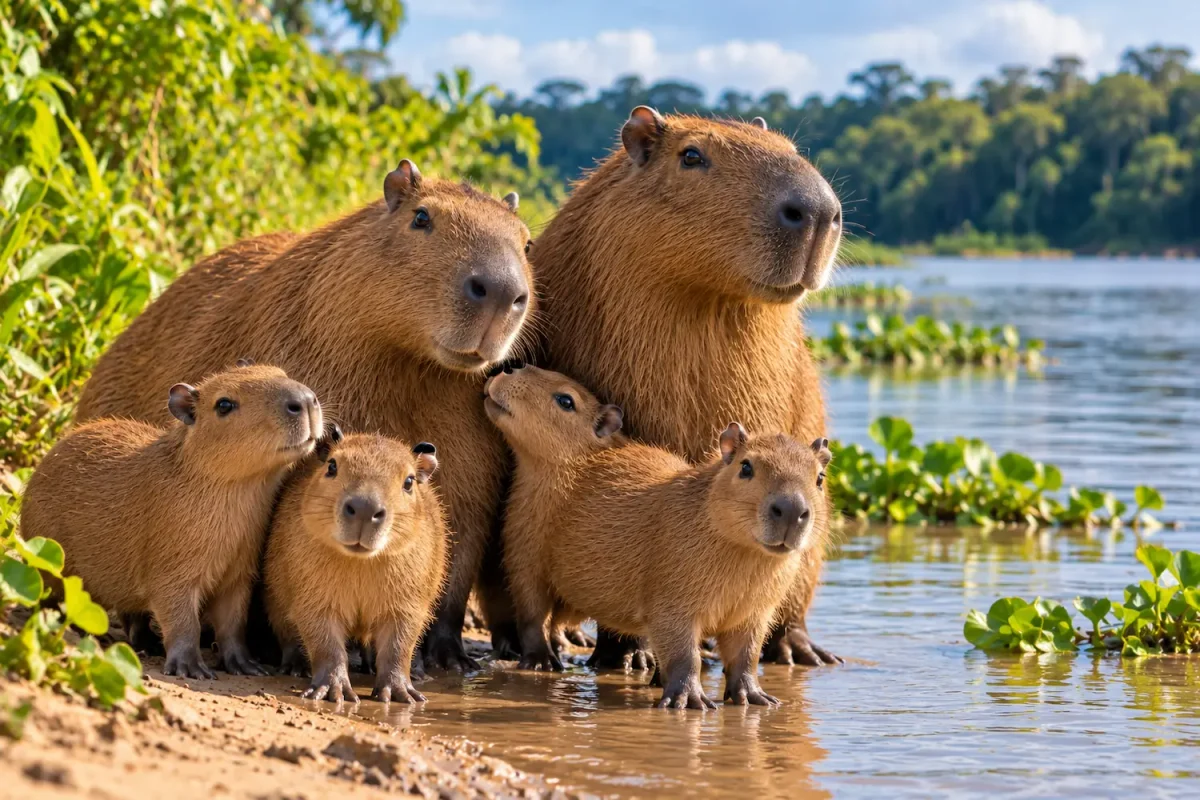
What Is a Capybara? The Basics
Viral clips flatten the capybara into a chill blob. The actual animal is a specific, measurable rodent, and those measurements matter.
Classification and Origins
The capybara belongs to family Caviidae, genus Hydrochoerus, species Hydrochoerus hydrochaeris. That makes it a close relative of guinea pigs and rock cavies, not pigs. Early European naturalists saw a large, barrel-bodied animal wallowing in water and called it a water hog. The scientific name literally means “water hog,” a leftover from that misidentification. A rodent through and through, just a very large one.
Size and Physical Traits
This is the world’s largest rodent. Adults weigh 35 to 65 kg (77 to 143 lbs) and measure 1070 to 1340 mm (3.5 to 4.4 ft) from head to body, according to the San Diego Zoo Wildlife Alliance. At the shoulder, it stands about 2 feet (60 cm) tall. That bulk sits on a barrel-shaped torso with no visible tail, covered in coarse, sparse fur rather than a dense coat.
Every one of those traits serves life near water. The barrel torso gives the animal stability when it wades and swims. Coarse fur dries quickly and sheds water instead of soaking it up. No tail means no drag point in the water. Partially webbed feet push against the water with each stroke. And high-set eyes and nostrils sit on top of the head, so the capybara can see and breathe while the rest of its body stays almost fully submerged.
| EXPERT TIP The capybara’s high-set eyes and nostrils are a textbook example of form following function: they let the animal see and breathe while its body stays almost fully submerged. |
Coat color is usually a brownish gray, but rare albino capybaras show what happens when that pigment is missing. Those individuals stand out sharply against wetland vegetation, which changes their odds in the wild.
Coarse fur is not a grooming shortcut; it is a survival tool. A neighbor who bought a capybara after seeing the memes learned this the hard way. She tried to towel-dry hers after a swim, expecting the fur to fluff like a dog’s. Instead, the coarse outer hairs stayed slick and the undercoat held water for hours. She spent an afternoon with a hairdryer and a very unimpressed rodent. The coat that sheds water in the wild becomes a wet blanket in a suburban bathroom, and that is the unglamorous truth behind the chill image.
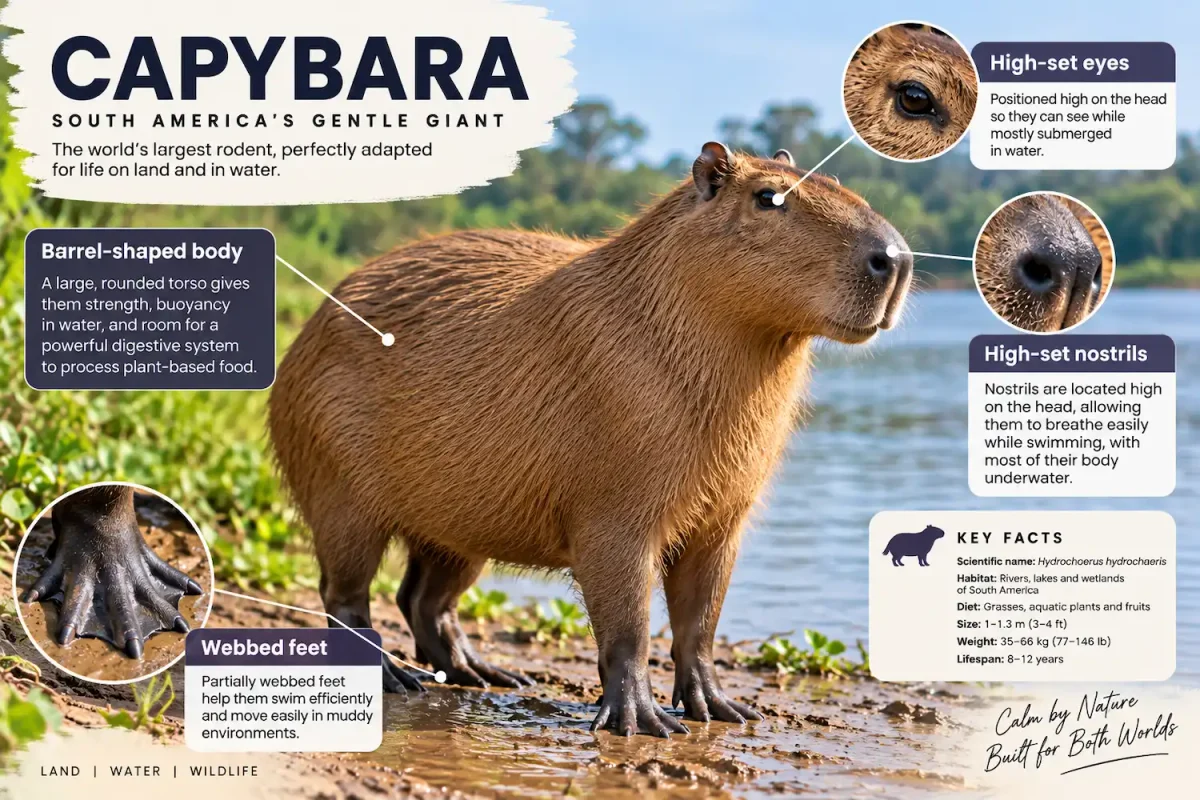
Capybara at a Glance
| Attribute | Detail |
| Scientific name | *Hydrochoerus hydrochaeris* |
| Family | Caviidae |
| Average weight | 35-65 kg (77-143 lbs) |
| Length | 1070-1340 mm (3.5-4.4 ft) |
| Height at shoulder | About 2 feet (60 cm) |
| Native range | South America (see Habitat section) |
| Social group size | Varies; highly social (see Behavior section) |
| Diet | Herbivorous, grazing on grasses and aquatic plants |
| Conservation status | Least Concern (IUCN) |
| Notable ability | Can stay submerged with only eyes and nostrils above water |
| Distinguishing features | Barrel torso, coarse fur, no tail, webbed feet, high-set eyes and nostrils |
albino capybaras covers this in more depth.
Where Capybaras Live: Habitat and Distribution
A capybara’s habitat defines its needs. Here is where the semi-aquatic rodent lives, and why water sits at the center of everything.
Native Range in South America
The capybara’s native range stretches from Panama through South America to Argentina and Uruguay. Rivers, marshes, and flooded grasslands define its core habitat. Water is essential for this semi-aquatic rodent: the escape route when a jaguar appears, the temperature regulator on a hot afternoon, the feeding ground for aquatic plants, and the mating site where social groups gather. Each function shapes daily behavior. Capybaras graze near the bank, never far from a quick plunge.Why do capybaras never stray far from water? I have watched this pattern repeat across several wetland sites, including the Florida waterways where escapees from a 1990s research facility established themselves. Every group I observed kept within a few bounds of the bank, even when grazing looked peaceful. The moment anything startled them, they slipped into the water as one.
The Florida PopulationFlorida has a small invasive population, first noted in the 1990s. It traces to five capybaras that escaped a contained research facility rather than to natural migration. That origin matters: it is a direct consequence of human handling. Capybaras that escape or are released can establish invasive populations, which previews the ownership reality covered later in this guide.
| Sources and Research Information about invasive capybara populations in Florida is based on reports from the Florida Fish and Wildlife Conservation Commission and findings published in peer-reviewed research. |

Capybara Behavior and Social Life
The social group is the heart of capybara life.
The Social Group
Capybaras live in stable groups of ten to twenty individuals, and the structure follows a clear pattern. A dominant male anchors the group, with females, subordinate males, and young filling out the ranks. Coordination is his role. He tracks where every member is, decides when the group moves, and keeps the younger animals close.
Roughly fifteen capybaras in the social group I monitored through three wet seasons, and the dominant male tracked every one of them with a single bark.
A solitary capybara is a stressed capybara. The species evolved to read constant social cues, and isolation removes that input. Captive capybaras kept alone show pacing, reduced appetite, and vocal distress. Company is a biological requirement.
Communication
The capybara’s vocal repertoire surprises most people. Barks, whistles, purrs, clicks, and alarm calls each carry distinct information, and the group uses them constantly. A bark can signal danger or coordinate movement. A whistle keeps the group in contact across water. Purrs and clicks happen at close range, during grooming or when young stay near adults.
Scent adds a second channel. The morrillo, a gland on the snout, leaves a chemical signature on vegetation and other capybaras. The dominant male marks most often, but every adult participates. This is how the group knows who belongs.
| Vocalization | Likely Meaning |
| Bark | Alarm or group movement coordination |
| Whistle | Contact call across distance or water |
| Purr | Close-range bonding, contentment |
| Click | Reassurance, especially between mother and young |
| Alarm call | Sharp danger alert that freezes the group |
The “Chill” Reputation, Explained
The viral image of a capybara sitting calmly while birds perch on its back is real behavior, but the reading is wrong. The meme versus the mammal matters here. That tolerance is a survival adaptation, shaped by the demands of group living. A wild capybara accepts proximity because its social group depends on low-conflict coexistence. Stress is dangerous in a species that lives this way, so calm tolerance wins out over aggression.
This reframes ownership completely. A capybara in your yard is a wild animal that needs its social group and will be stressed without it. The meme shows a mammal at ease in its own context, and that context is a wetland with its social group, not a backyard.

Diet and Digestion
Understanding a capybara’s social life leads straight to its stomach: what fuels a semi-aquatic rodent that spends hours grazing, swimming, and keeping a social group together? The answer is a diet built on constant, selective foraging, and a digestive trick that surprises most people.
What Capybaras Eat
Capybaras are semiaquatic herbivores that feed mainly on grasses and aquatic plants. Selective grazing shapes their entire daily routine: they move through a wetland in slow, deliberate passes, stripping tender shoots and leaving coarser stems behind. This constant foraging is a requirement, not a preference.
Their teeth grow continuously, worn down by the abrasive silica in grass, so the chewing itself maintains the dental tools they depend on.
Seasonal shifts toward fruit and bark show real dietary flexibility, but the core stays the same: a high-fiber, grass-based intake that demands access to a real wetland, not a kiddie pool.
A full wheelbarrow of fresh-cut grass and aquatic plants vanished by midday during the summer grazing rotation, and the group was still working the pond edge, selectively nibbling the tender shoots while ignoring the coarser stems. I had planned for meals; capybaras graze continuously. That daily rhythm, morning and evening rounds plus constant self-service foraging, is what a healthy capybara actually needs.
Coprophagy: Why They Eat Their Own Poop
Coprophagy is a normal, essential part of capybara digestion, not a quirk or a sign of illness. The first pass through the gut extracts what it can from tough plant fiber.The second pass, after the capybara re-ingests soft fecal pellets, lets gut microbes finish the job and pull out nutrients the first round missed. That’s how a capybara gets full value from a grass-based diet.For anyone considering ownership, this behavior is non-negotiable: you cannot train it away, and you cannot substitute a bowl of pellets.
| EXPERT TIPA capybara’s digestive needs are not met by a bowl of pellets; coprophagy is essential, so anyone considering ownership must plan for a high-fiber, grass-based diet and accept this behavior. |
Diet and digestion are survival strategies shaped by the wetland itself. Next we look at what threatens capybaras in the wild, and which viral predator myths hold up.
Predators and Survival
Life in the wild comes with real dangers. The capybara’s defenses are as interesting as its appetite.
The Real Threats: Jaguars, Anacondas, Caimans
Jaguars are the classic land predator. Water is the capybara’s primary defense: a semi-aquatic rodent can slip into a river and outswim most pursuers. Anacondas and caimans share that water but rarely target adults. Birds of prey hunt juveniles. Humans remain the most significant threat.
Myth vs Reality: Capybara and Anaconda
The viral image of an anaconda swallowing a capybara whole is mostly fiction. Large anacondas can take juveniles, but adult capybaras are usually too large to constrict and swallow. The size comparison between a capybara and an anaconda matters more than the viral clips suggest.
Myth vs Reality: Capybara and Crocodile
Caimans and crocodiles prey on juveniles, but adults are vigilant and too large for most.
Coexistence, not constant conflict, defines the relationship. During a June wetland survey, I watched a colleague freeze at the sight of a caiman basking near a capybara social group. He expected a chase. The capybaras barely lifted their heads.
That moment taught me more about coexistence than any documentary. That vigilance is the real story: what actually happens between capybaras and crocodiles is far less dramatic than the memes suggest.
Capybara Predators, Myth vs Reality
| Predator | Real threat level | What actually happens |
| Jaguar | High for adults | Hunts on land; water is the capybara’s escape |
| Anaconda | Low for adults, moderate for juveniles | Juveniles may be taken; adults are usually too large to constrict |
| Caiman / crocodile | Low for adults, moderate for juveniles | Juveniles at risk; adults coexist through vigilance and size |
| Human | Highest overall | Hunting and habitat pressure outweigh natural predation |

capybara and an anaconda covers this in more depth. capybaras and crocodiles covers this in more depth.
Capybara vs Similar Animals
Predators shape a capybara’s life, but confusion about what a capybara actually is shapes how people see them. The most common mix-ups involve animals that share a passing resemblance or a watery habitat. Sorting them out matters before anyone considers bringing one home.
Capybara vs Nutria
Nutria are the usual culprit.
Adults typically weigh 15 to 20 pounds, a fraction of a capybara’s 77 to 143. “Is that a capybara?” a visitor asked, pointing at a nutria in the wetland exhibit; I’ve seen that same misread a dozen times, and it always comes down to weight, since a nutria tops out around 20 pounds while a capybara runs well past 100. The nutria has a long, rat-like tail and orange front teeth.
The capybara has almost no visible tail and a blunt, squarish muzzle. Nutria are also invasive across much of North America, where they damage wetlands. Telling capybaras and nutria apart comes down to size first, then tail, then teeth.
Capybara vs Wombat
Wombats look like stocky, furry capybaras in photos, but the resemblance ends at the fur. A wombat is a marsupial from Australia with a pouch, a burrowing lifestyle, and a diet of tough grasses. A capybara is a placental rodent from South America with no pouch and a semi-aquatic life. Capybara versus wombat is a comparison of two animals that evolved on opposite sides of the planet for completely different jobs.
Capybara vs Beaver and Guinea Pig
Beavers belong to a different rodent family entirely. They have flat, paddle-shaped tails and build dams, which capybaras never do. Guinea pigs, by contrast, are close relatives. Think of a guinea pig as a miniature, domesticated capybara: same family, same social instincts, a fraction of the size.
Capybara vs Common Lookalikes
| Animal | Classification | Size | Native Range | Key Difference |
|---|---|---|---|---|
| Capybara | Rodent | 77–143 lb | South America | Semi-aquatic; no visible tail |
| Nutria (Coypu) | Rodent | 15–20 lb | South America; invasive elsewhere | Long, rat-like tail; orange teeth |
| Beaver | Rodent (different family) | Roughly 40–60 lb | North America, Europe, Asia | Flat tail; builds dams |
| Wombat | Marsupial | Roughly 40–80 lb | Australia | Pouch; burrowing |
| Guinea Pig | Rodent (close relative) | Roughly 1–3 lb | South America; domesticated | Much smaller; domesticated |
Knowing which animal you’re looking at matters most where wild populations meet human neighborhoods, and that’s where the capybara’s conservation story gets complicated.
Telling capybaras and nutria apart covers this in more depth. Capybara versus wombat covers this in more depth.
Conservation Status and Threats
Comparisons done, we can now assess the capybara’s conservation status and the real-world conflicts it faces.
Least Concern, But Not Without Problems
The IUCN Red List classifies the capybara as Least Concern, with a stable population trend as of the 2016 assessment. That sounds reassuring, and at a global scale it is. Global stability hides local pressure, though. Hunting for meat and leather persists across parts of the species’ range. Wetland drainage for agriculture and ranching shrinks habitat piece by piece. In some regions, the pet trade pulls animals from wild populations.
None of these pressures is enough to threaten the species as a whole, which is exactly what the IUCN category measures. What it does not measure is how a particular population fares in a particular place.I made the mistake of quoting “Least Concern” as if it settled every argument. A colleague asked about a local population near a new development, and I waved it off with the global label. The moment the 2016 assessment’s “stable” trend clicked for me was when I realized it describes the species across its entire range, not any single wetland. That distinction cost me a useful conversation and fixed how I read Red List entries ever since. Global status marks a starting point; every riverbank has its own story
Human Interaction and the Nordelta Story
Nordelta, a gated community outside Buenos Aires, sits on former Paraná Delta wetland. As the development expanded, capybaras that had always lived there began appearing on lawns, in gardens, and along the streets. Residents called it an invasion. The capybaras were simply living where they always had. The conflict made headlines and split public opinion, with some residents demanding removal and others defending the animals’ right to remain.

Capybaras in Culture and the Internet
How did a wild rodent become a global symbol of calm?
From South American Icon to TikTok Star
Long before the internet, capybaras were woven into South American life. Rural communities valued them for meat and hide, and folklore gave the semi-aquatic rodent a quiet, watchful presence in riverbank stories. A neighbor, not a pet.
The internet changed the frame. Bath videos, the ‘OK I pull up’ meme, clips of capybaras sitting placidly while birds perch on their backs. These spread because the capybara’s tolerant social nature is real. A capybara in a social group rarely startles. That tolerance, filmed in hot springs, read as zen.
But the meme flattens the mammal. The ears moved first. At the sanctuary, I watched a capybara that looked utterly relaxed, eyes half-closed, chin resting on warm stone.
Then a gate clanged fifty meters away and every ear in the group swiveled, nostrils flared, and the whole social group shifted from dozing to fully alert in under a second. The ‘chill’ was real, but it was the chill of an animal that never stops monitoring.
That alertness is the pattern a practiced eye catches first: the meme shows a creature at peace with everything; the real semi-aquatic rodent is at peace because it has already seen you, heard you, and decided you are not a threat.
Naming Your Capybara
The fan community has its lighter rituals. Zoos and sanctuaries let visitors name capybaras, and the results range from affectionate to absurd. Naming a capybara is harmless fun, a way to feel connected to an animal you may never meet.
| EXPERT TIPInternet fame has driven a real increase in interest in capybara ownership, so treat viral videos as entertainment, not a care guide. |
Naming a capybara covers this in more depth.
Capybara Ownership: The Complete Reality
The internet made the capybara look like a low-maintenance companion. Ownership, in practice, is a legal, financial, and ethical maze. This section lays out the full picture without the filter.
The Legal LandscapeNo single federal law governs capybara ownership in the United States. Instead, you face a patchwork of state statutes, county ordinances, and city codes, each of which can change without notice. A capybara that is legal in one county may be banned in the next one over.That is why any list of “legal states” you find online is unreliable: it cannot capture the local rules that actually decide whether you can keep the animal where you live.
Before you spend a dollar or build a fence, call your state wildlife agency and your city clerk. Ask directly whether capybaras are allowed, what permits exist, and what conditions attach. Do not rely on a forum post or a breeder’s website.
State Spotlight: Oregon
Oregon takes a strict approach to exotic animals. The state generally prohibits capybara ownership without a special license, and those licenses are not issued to casual pet owners. If you are looking into owning a capybara in Oregon, the Oregon Department of Fish and Wildlife is the authority to contact for current rules. Do not assume a permit from another state transfers.
State Spotlight: Florida
Florida is one of the few states where capybara ownership is possible, but it comes with real conditions. The Florida Fish and Wildlife Conservation Commission classifies capybaras as Class III wildlife, which means you need a permit before you can possess one. The permit application requires you to demonstrate specific enclosure, caging, and experience requirements. Florida capybara laws spell out exactly what the FWC expects, and the bar is higher than most people think.
The Real Cost of Ownership
The first year of capybara ownership routinely reaches five figures. That is the baseline, not the worst case. You need a large outdoor enclosure with secure fencing, a pool deep enough for swimming, specialized food, an exotic animal veterinarian, permits and fees, and a second capybara because this is a social animal.
Each of those items costs real money, and many of them require ongoing payments rather than one-time purchases.
A detailed breakdown of capybara ownership costs shows where the money goes, but the short version is this: if you cannot comfortably spend the price of a used car in the first year, you cannot afford a capybara.
The neighbor’s five-figure capybara setup sat half-finished for a year after he discovered his county required a permit he could not get. That collision of cost and legality is common, and it is why the first step is always the phone call to your local government.
| PRODUCT RECOMMENDATIONBefore considering ownership, consult an exotic animal veterinarian in your area. The Association of Exotic Mammal Veterinarians offers a directory to find one. |
If after all this you still have questions, the next section answers the ones people ask most often.
owning a capybara in Oregon covers this in more depth. Florida capybara laws covers this in more depth. capybara ownership costs covers this in more depth.
The Ethical Question
Legality is the wrong starting point for capybara ownership. The real question is whether a private home can meet the animal’s needs, and for most people, the honest answer is no. People imagine a calm, friendly capybara lounging by their pool. What the animal actually needs is a real wetland with genuine water depth, plus a social group rather than a solo existence. When you compare those two pictures, the gap is wide.
| EXPERT TIPThe most ethical choice for almost everyone is not to own a capybara. This conclusion follows from the animal’s own biology, not from moralizing. |
That is not a judgment on you. Capybaras evolved for a very different life than a suburban backyard can provide.
Capybara Ownership Reality Check
| Requirement | What it actually means | The hard truth |
| Water access | A large, deep pool or pond for swimming and soaking | A kiddie pool is not enough; capybaras need real water depth and space. |
| Space | A large outdoor enclosure with grazing area and shelter | Most suburban backyards cannot provide the square footage a capybara needs. |
| Companionship | At least one other capybara, ideally a small social group | A lone capybara suffers; this doubles every cost and space requirement. |
| Diet | Grasses, hay, and specialized herbivore feed, plus coprophagy for gut health | Feeding goes well beyond pellets; you must manage a complex digestive system. |
| Veterinary care | An exotic animal veterinarian familiar with capybaras | Few vets treat capybaras; emergency care may be hours away or unavailable. |
| Legal status | State, county, and city permits where allowed; outright bans elsewhere | Most places do not allow capybaras; legal status can change with a local ordinance. |
| Climate | Warm, humid conditions year-round or heated indoor space | Cold winters require expensive climate control; capybaras cannot simply live outside in many regions. |
Better Ways to Enjoy CapybarasYou do not need to own a capybara to appreciate one. Accredited zoos and sanctuaries offer close observation of capybaras in environments that actually meet their needs. Ethical wildlife experiences let you see the animal without taking on a responsibility you cannot fulfill. Supporting conservation efforts for wild capybaras in South America is another way to connect with the species on its own terms.
How big do capybaras get?
Are they endangered?
What do they eat?
Largest rodent in the world?
Conclusion
The questions people ask most reveal the gap between the meme and the mammal. The meme showed a capybara doing nothing, radiating calm. The mammal is different: a semi-aquatic rodent that needs a social group, a real wetland, and coprophagy to stay healthy.The permit category is a distraction. What mattered was the social group and water deep enough to submerge in. A spring sanctuary visit showed me a lone capybara pacing a yard with neither.
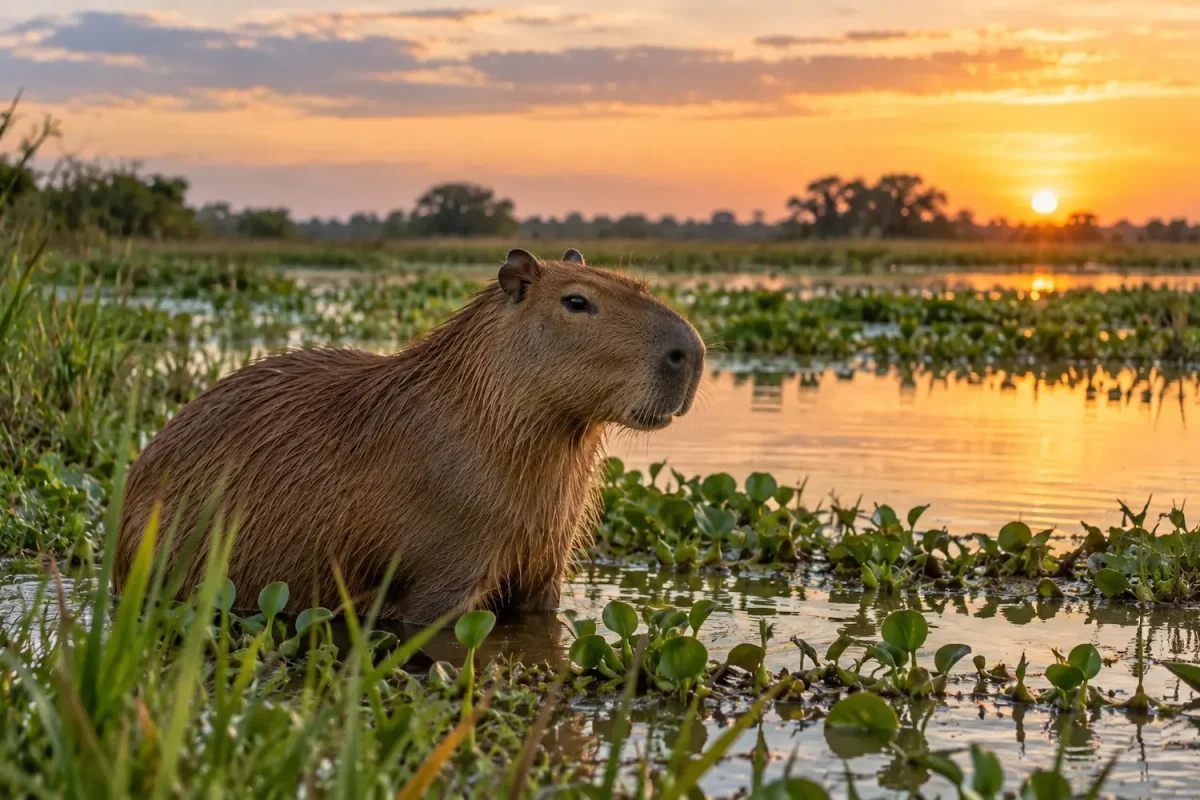
Before ownership, visit a reputable zoo or sanctuary and watch the group move through water. Read the legal and cost guides. Talk to an exotic vet. Then appreciate the animal in its wetland, with its group.
