
Do Crocodiles Really Eat Capybaras? Unpacking the Truth Behind the Viral Coexistence
April 8, 2026
Summer Heat Safety Guide for Exotic Pets & Dogs Tips, Gear & Emergency Care
July 17, 2026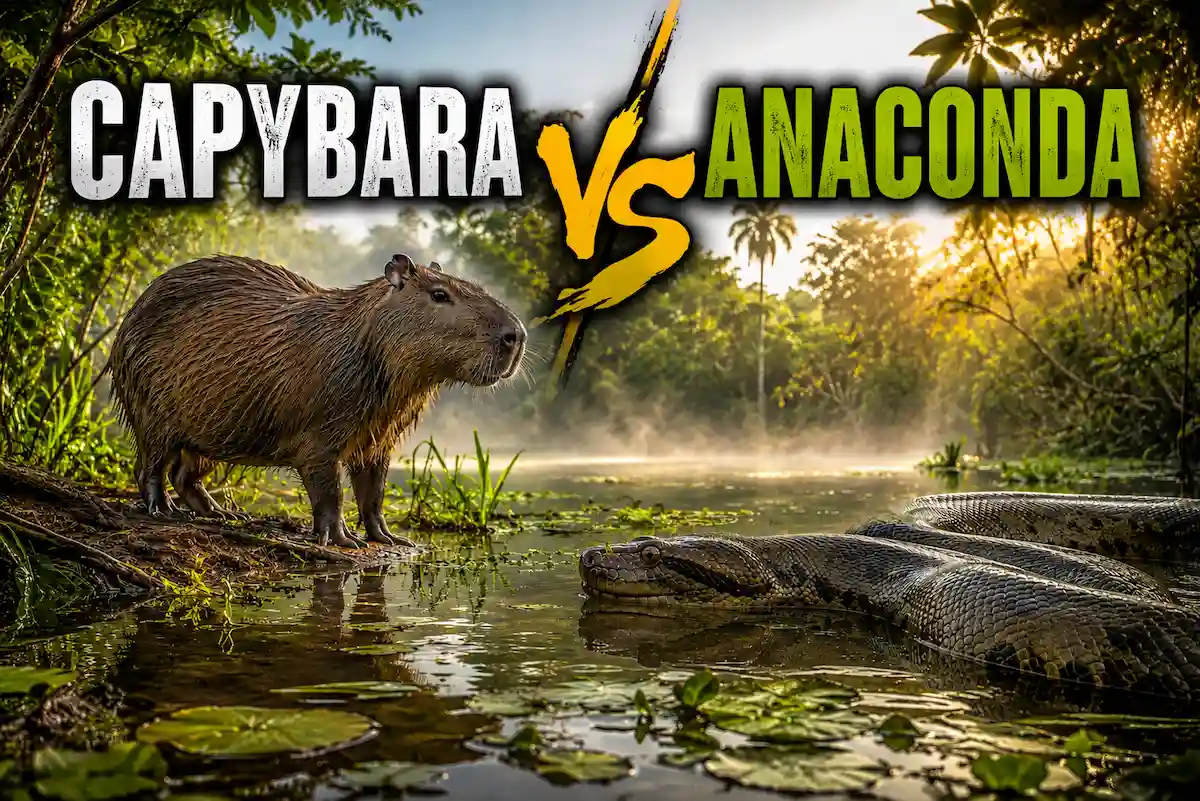
Moving Beyond the Battle Arena
Type "capybara vs anaconda" into a search bar and you get a fight card. Stat blocks. Bite force rankings lifted from nowhere. A green anaconda rendered as an eight-meter river monster squaring off against a capybara that exists, in these accounts, only to be eaten. It is wildlife content staged like a scheduled bout, and it has trained a generation of readers to think about two of the Amazon basin's most important animals in exactly the wrong way.
You have probably seen the photo. The one where a snake's coils fill the frame and a capybara looks the size of a house cat beside it, shot from an angle that does all the lying for the photographer. You have scrolled through the fan wikis where every anaconda measurement creeps a little higher than the last one, where "experts say" carries no name and no citation. Trying to find a number you could actually put in a classroom slide or repeat to a curious eight-year-old without embarrassing yourself later starts to feel like fact-checking a tabloid. That is not how anyone should have to learn about wetland ecology.
So this guide does something different. We are going to profile the capybara and the green anaconda separately first, on their own biological terms, before we ever put them side by side. Then we compare verified measurements, the kind backed by museum specimens and published field studies rather than forum lore. Finally, we look at what documented field observations actually show about how these two species interact in the flooded grasslands and river systems of South America, because the real answer is far more interesting than a fight outcome. You will come away with accurate data, some conservation context that usually gets skipped, and a working understanding of how two large wetland animals coexist on the same floodplain without it constantly ending in violence. No "ultimate showdown" required. Just the numbers, and what they actually mean.
Taxonomy & Natural History of Both Species
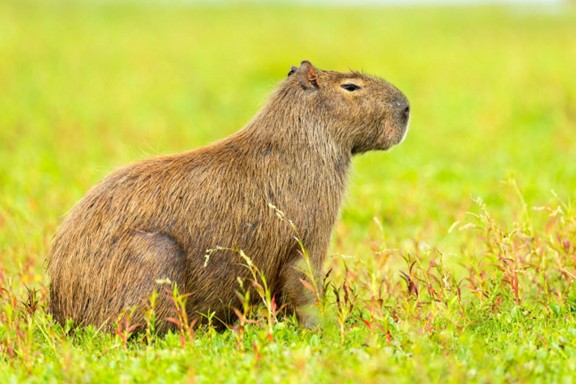
Capybara: The Rodent That Rewrote the Size Limit
The capybara belongs to the family Caviidae, the same broad lineage that gave us the domestic guinea pig, but calling it a "giant guinea pig" undersells what is actually going on. It sits in its own genus, Hydrochoerus, alongside one close relative, the lesser capybara. That taxonomic separation matters. Guinea pigs are terrestrial. Capybaras are not, and the differences run deeper than size.
Semi-aquatic life is not a lifestyle preference for a capybara. It is the defining trait of the genus. Their eyes, ears, and nostrils sit high on the skull, arranged so the animal can submerge its body almost entirely while keeping all three senses above the waterline. Their feet are partially webbed. They can hold their breath underwater for several minutes when pressed, often as an escape response from a predator on land. None of this is incidental plumbing. It is the architecture of an animal built around permanent access to water.
The rest of the biology follows the same logic. Capybara coat hair is coarse and sparse compared to most mammals their size, an adaptation that sheds water efficiently rather than trapping it. Scent glands, a nasal gland in males and an anal gland in both sexes, mark territory and floodplain resources in a habitat where visual landmarks shift with the flood cycle. And their digestive system is built around grazing, heavily fibrous wetland grasses, with a hindgut fermentation strategy efficient enough to support a body that can exceed fifty kilograms. That is enormous for a rodent. It is unremarkable for a wetland grazer.
Green Anaconda: Sex, Size & Snake Biology
The green anaconda's scientific name is Eunectes murinus. Eunectes translates roughly to "good swimmer." Murinus references a mouse-like coloration noted in early taxonomic description, not diet, despite what a surprising number of pages online seem to assume. It sits within Boidae, the boa family, a lineage of non-venomous constrictors that subdue prey through restriction rather than toxin. That single fact eliminates a huge share of the venom-related misinformation circulating about this species before we even get to size.
Reproduction is where anaconda biology gets genuinely interesting, and where most viral content goes quiet because the real story does not fit a combat narrative. Green anacondas are ovoviviparous. Females retain developing eggs internally and give live birth, an energetically expensive strategy that demands a large maternal body to sustain a sizeable clutch through gestation. This reproductive pressure has shaped the entire size structure of the species.
Expert Tip
Why "Versus" Framing Fails Ecological Reality
Here is the part that gets lost in every battle-wiki thread. Capybaras and green anacondas are not scheduled opponents meeting in an arena. They are seasonal neighbors, sharing the same flooded grasslands, the same river margins, the same resource that makes both their lives possible: water that does not disappear for months at a time. Their overlap is a matter of geography and habitat preference, not rivalry.
The curiosity behind a "capybara vs anaconda" search is legitimate. People want to know what happens when a large rodent and a large constrictor occupy the same wetland. That is a real ecological question, and it deserves a real ecological answer; it does not require inventing a fictional combat narrative to satisfy it. The actual story, predator and prey navigating risk, season, size, and opportunity within a shared floodplain, holds up fine without embellishment.
That is the structure this guide follows from here forward. Profile each species first, on its own terms. Compare verified measurements second. Then look at what documented field interactions actually show. Genuine educational value and genuine curiosity can be served by the same article, without either one being sacrificed to the other.
Anatomy, Size & Verified Measurements
Methodology Matters: How Biologists Measure Wild Giants
Before a single number gets compared, it is worth asking where that number came from, because this is exactly where most viral content quietly falls apart.
Wildlife biologists draw size data from three distinct sources, and they are not interchangeable. Field captures involve a live animal, restrained briefly, measured by a researcher with calipers or a measuring tape, then released. Museum vouchers are preserved specimens with a permanent physical record that other scientists can re-examine decades later. Published morphometric studies aggregate measurements across many individuals, field-captured or vouchered, to establish population-level averages with actual statistical weight behind them. A number with none of these behind it is not a measurement. It is a claim.
This matters enormously for anacondas in particular, because captive specimens skew the public's sense of what "normal" looks like. A zoo anaconda fed on a predictable schedule, with no energy spent hunting, evading predators, or surviving seasonal drought, will often grow larger than its wild counterparts ever do. That captive animal is not lying about its size. It is simply not a representative baseline for what the species does under natural conditions, and treating it as one is how "thirty-foot anaconda" claims keep finding their way back into circulation.

Expert Tip
🐾 Side-by-Side Physical Specifications
| Attribute | 🦫 Capybara | 🐍 Green Anaconda |
|---|---|---|
| Scientific Name | Hydrochoerus hydrochaeris | Eunectes murinus |
| Average Adult Length | 1.0–1.3 m (3.3–4.3 ft) | Female: 4.5–5.5 m (15–18 ft) Male: ~2.5–3.0 m (8–10 ft) |
| Verified Record Length | ~1.34 m (4.4 ft) | ~6.6 m (21.7 ft) — disputed; reliably verified specimens rarely exceed 5.5 m |
| Average Adult Mass | 35–66 kg (77–146 lb) | Female: 100–150 kg (220–330 lb) Male: ~30–40 kg (66–88 lb) |
| Verified Record Mass | ~91 kg (200 lb) | ~227 kg (500 lb) — exceptional; wild averages are lower |
| Average Lifespan (Wild) | 6–10 years | 10–12 years |
| Sexual Maturity | 15–18 months | Female: 3–4 years Male: 18 months–2 years |
| Dentition | Chisel-like incisors; 20 teeth total | Aglyphous (rear-fanged); ~100 recurved, non-venomous teeth |
| Primary Locomotion | Semi-aquatic quadruped; partially webbed feet | Fully aquatic lateral undulation; constrictor |
Unless otherwise noted, anaconda figures above describe sexually mature females, since they represent the species' upper size range and the figure most often misquoted online. Male anacondas should never be assumed when a generic "anaconda size" claim appears without a specified sex.
A few things in this table deserve a second look rather than a skim. The capybara's record mass, at roughly 91 kilograms, is genuinely exceptional and not something you should expect to encounter on an average Pantanal sighting; most adults sit well below that figure. And that disputed 6.6-meter anaconda length sits in the table specifically because it needs to be seen and contextualized, not erased. Historical claims at that scale, and the famous "thirty-foot" figures that circulate well past it, consistently lack a voucher specimen. No preserved snake, no verifiable measurement, no scientist's name attached to the claim. That absence is the whole story.
Visual Scale: Silhouettes Drawn to Real Averages
Here is a habit worth building, whether you are writing about wildlife or just trying to read about it more carefully: averages tell you what an encounter will actually look like. Record outliers tell you almost nothing, because by definition they describe the rarest individual ever documented, not the wetland neighbor you are statistically likely to meet.
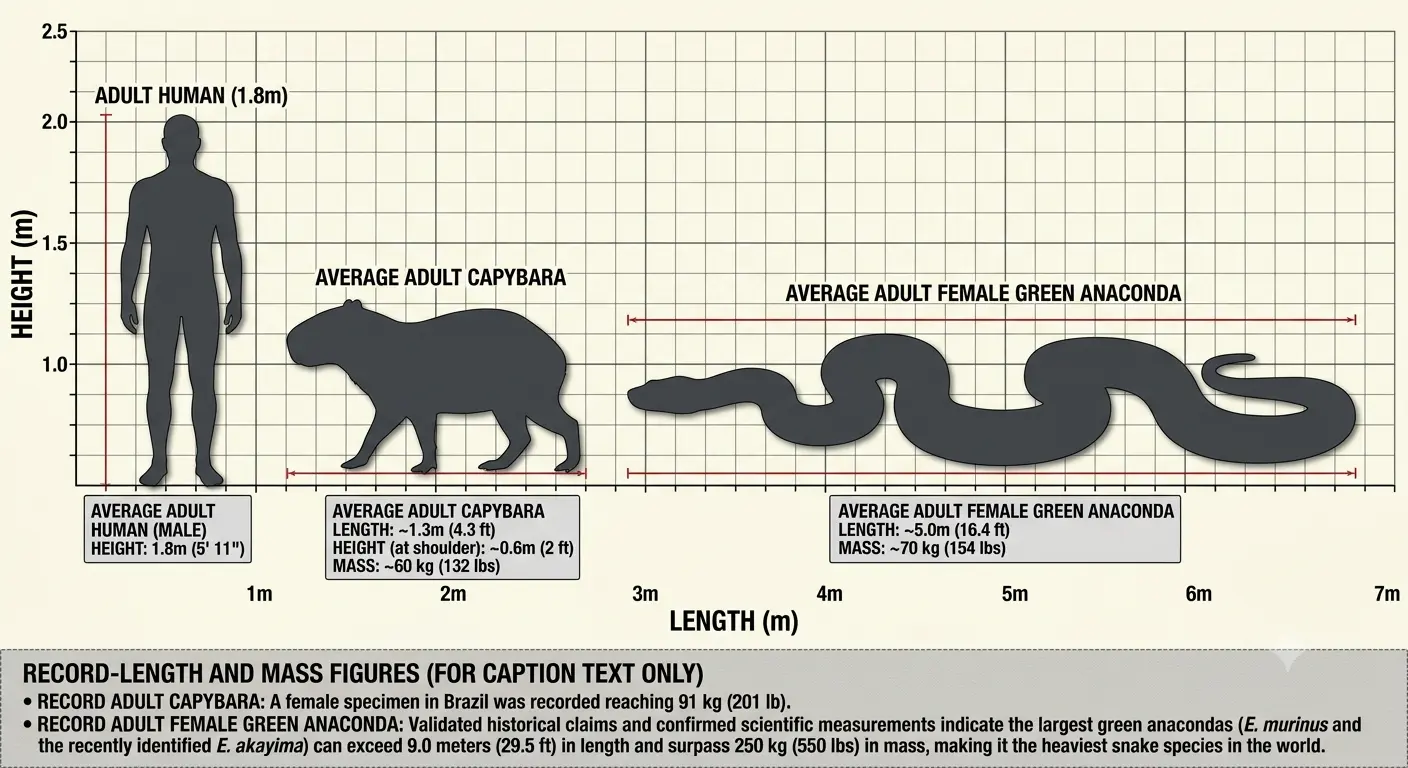
Drawn this way, the comparison stops being dramatic and starts being useful. A capybara at roughly 1.1 meters and a female anaconda at roughly 5 meters, set against a human silhouette, gives you an honest sense of scale; no forced perspective doing the work for you.
That phrase, forced perspective, is worth learning to spot on sight. It is the single most common trick behind the "giant anaconda" photos that circulate every few months. Shoot a snake's coils close to the lens while the camera holding the mammal or person further back, and the size relationship in the frame has nothing to do with the size relationship in reality. A snake photographed three meters closer to the camera than the animal beside it will look two or three times larger than it actually is, simply because of how perspective and focal length compress distance in a photograph.
Expert Tip
Geography, Range & Shared Wetlands
Where Capybaras Rule the Shoreline
Capybaras occupy an enormous range across South America, but "range" is a deceptively broad word for an animal this dependent on a single resource. They are present throughout the Pantanal, the Amazon basin, the Llanos of Venezuela and Colombia, and the Orinoco river system, essentially anywhere permanent freshwater meets grassland or floodplain. That last qualifier matters more than the geography itself.
Water is not a convenience for a capybara. It is the foundation of nearly everything the species does. Thermoregulation depends on it; a capybara overheats quickly in tropical heat and uses water to cool down the way other large mammals use shade. Escape from jaguars, pumas, and caimans depends on it; a capybara's first defensive move is almost always toward the nearest water body, where it can submerge and outmanoeuvre a land predator. Foraging depends on it too, since the fibrous floodplain grasses capybaras graze on grow precisely where seasonal flooding deposits nutrients. Take away permanent water access and you do not get a smaller capybara population. You get no capybara population at all.
Where Anacondas Rule the Shallows
Green anacondas range across a similarly broad swath of the continent: Venezuela, Brazil, Colombia, Ecuador, Peru, and Bolivia, concentrated in slow-moving freshwater systems rather than fast rivers or open water. Swamps, marshes, flooded grasslands, and quiet river margins suit an ambush predator built for stillness far better than a current does.
Their movement through this range is not constant. It is driven by flood pulses, the seasonal rise and fall of water levels that defines life across the Llanos and the Pantanal alike. As wet-season floods recede and lagoons begin drying down, anacondas concentrate around whatever water remains, sometimes burrowing into mud or aestivating through the driest months in a state of reduced activity. When the floods return, they disperse back across the reopened wetland. This is not aimless wandering. It is a predator tracking the only resource that makes its hunting strategy work.
Mapping the Overlap: Pantanal, Amazon Basin & Orinoco
Here is where a lot of casual range maps mislead people. Two species can share a continent without their home ranges ever meaningfully intersecting, and "South America" is not a useful unit for predicting an encounter. The genuine overlap between capybaras and green anacondas is narrower and more specific: the seasonally flooded grasslands of the Pantanal, certain slow-water tributaries and oxbow systems within the Amazon basin, and the Llanos-Orinoco floodplain shared between Venezuela and Colombia. These ecoregions combine exactly the conditions both species require, permanent or semi-permanent water bordered by accessible grazing land, and that combination is the actual predictor of co-occurrence, not a shared continental outline.
Even within those overlap zones, the two species are not really competing for the same square meter of habitat. Capybaras spend the bulk of their time grazing along shorelines and shallow margins, visible, mobile, and alert. Anacondas favor submerged ambush points just off those same shorelines, motionless, often partially buried in mud or vegetation, waiting rather than searching. This is microhabitat partitioning: two large animals using adjacent but distinct parts of the same wetland, in ways that minimize constant direct interaction rather than maximize it.
Field research out of the Pantanal and the Venezuelan Llanos, the same regions cited in published morphometric work on both species, is what actually grounds this overlap in something verifiable. Peer-reviewed ecology, not a forum thread speculating about which animal would win.
Seasonal Rhythms: Flood, Drought & Behavior
Encounter probability between these two species is not a fixed constant. It swings hard across the year, and water level is the variable driving almost all of it.
During the wet season, when floodwaters spread across the grassland, both species disperse across a much larger area. Capybaras have more shoreline to graze. Anacondas have more submerged territory to hunt across. Encounters happen, but they are diluted across a wide landscape. The dry season compresses everything. As lagoons shrink and water bodies become scarce, both species concentrate around whatever remains, sometimes the same shrinking pond, sometimes adjacent ones. This is when spatial overlap, and therefore the realistic probability of an actual encounter, climbs sharply.
Expert Tip
Behavioral Ecology & Daily Rhythms
Capybara Society: Herds, Alarm Calls & Vigilance
Capybaras are not solitary animals, and that fact alone reshapes how you should think about their vulnerability. Typical herds run anywhere from a handful of individuals to twenty or more, usually structured around a dominant male, several adult females, and a mix of juveniles and subordinate males held at the periphery. This is not a loose aggregation. It is a working social unit with a division of vigilance built into it.
Sentinel behavior is the clearest expression of that structure. At any given moment, while most of the herd grazes with heads down, one or more individuals remain alert, scanning the surrounding vegetation and waterline. The moment a sentinel detects a potential threat, jaguar, caiman, or anything else, a sharp alarm call travels through the group almost instantly, and dozens of capybaras can be moving toward water within seconds. That collective response is itself a deterrent. A solitary ambush predator depends on surprise, on a target that does not see it coming. A herd with rotating sentinels and an instant alarm system removes most of that surprise before a predator ever gets close enough to strike.
Expert Tip
Anaconda Ecology: Ambush, Constriction & Energy Budget
Where capybara defense runs on vigilance, anaconda predation runs on patience, and the two strategies exist for related reasons. An anaconda is a sit-and-wait predator. It does not chase. It positions itself, often submerged with only its eyes above the waterline, and waits for prey to come within striking range, then relies on a fast initial strike and constriction rather than pursuit.
This is not laziness. It is energy budgeting. A large constrictor's metabolism is comparatively slow, and a big strike-and-hold predation event is metabolically expensive enough that the species cannot afford to waste that effort on long chases with uncertain outcomes. Thermoregulation reinforces the same constraint. As an ectotherm, an anaconda's muscular performance depends heavily on body temperature, and sustained high-speed pursuit, on land or in water, is simply not part of the available toolkit the way it would be for a warm-blooded predator. The entire strategy is built around minimizing energy expenditure until the moment of the strike itself.
A 24-Hour Wetland Clock: Parallel Activity Timelines
One of the more useful things published behavioral data reveals, and one viral content almost never mentions, is just how little overlap there actually is between when a capybara is active and when an anaconda is hunting.
[Visual: a synchronized 24-hour behavioral clock with two concentric rings, one for each species, showing activity state by time of day. Color-code grazing/social/rest phases for the capybara ring and submerged/ambush/active-hunting phases for the anaconda ring, so the visual overlap, or lack of it, is immediately legible.]
- Dawn (05:30–07:00): Capybaras begin grazing in open grassland as light increases. Anacondas, by contrast, are winding down from nocturnal hunting and retreating toward submerged thermoregulation spots.
- Mid-morning (07:00–11:00): Capybaras often move into deeper water to rest and ruminate. Anacondas remain largely cryptic during this window, minimally active.
- Midday (11:00–15:00): This is peak capybara social activity, grooming bouts, herd interaction, general daytime business. Anacondas are typically basking or fully submerged, conserving energy through the hottest part of the day.
- Late afternoon (15:00–18:00): Capybaras resume grazing as temperatures ease. Anacondas begin repositioning, shifting toward the ambush points they will use once light fades.
- Night (18:00–05:30): Capybaras return to shoreline sleeping sites, still under herd vigilance even at rest. This is precisely when anacondas enter their peak hunting and movement phase.
Laid out this way, the picture that emerges is not constant tension. It is two species running on largely separate temporal tracks, with a narrow window of genuine overlap concentrated around dusk and the earliest hours of night. Most of a capybara's day and most of an anaconda's day simply do not intersect.
Aquatic Adaptations: The Real Decider
If there is a single factor that shapes outcomes more than anything resembling a "fight," it is water, and specifically how well each species is built to use it.
Capybaras bring partially webbed feet, eyes and nostrils positioned high on the skull for low-profile swimming, and a breath-holding capacity that can stretch several minutes underwater when escape is the priority. That combination makes submerged retreat a genuinely reliable defense, not a desperate last resort.
Anacondas bring their own water-specific design: lung positioning adapted for buoyancy control and extended submersion, eyes set high on the head for the same low-profile surveillance capybaras use in reverse, and a constriction mechanism that loses none of its effectiveness underwater the way a bite-and-hold strategy might for a land predator. Submersion does not disadvantage an anaconda the way it would most terrestrial hunters; it is the medium the species is built for.
Expert Tip
Evidence-Based Encounters: Predation, Defense & Coexistence
What the Field Data Actually Says About Predation
This is the section where most viral content simply stops doing homework, so it is worth being precise about what actually exists in the literature versus what gets repeated because it sounds plausible.
Evidence for anaconda predation on capybaras comes from three sources: stomach content analyses performed on captured or deceased specimens, direct field observations by researchers present at the moment of predation, and, more recently, trail-camera footage left running in known overlap zones. Of these, direct observations and verified stomach contents carry the most weight, because they remove guesswork about what was actually eaten and by what.
What this evidence consistently shows is a sharp split by age class. Juvenile and young capybaras appear in documented predation accounts with some regularity. They are smaller, less experienced at reading threat cues, and not yet fully integrated into a herd's vigilance system. Adult capybaras are a different matter entirely. Documented, verified cases of an anaconda successfully predating a healthy adult capybara are genuinely scarce in the literature. Most of what circulates about adult predation is circumstantial: an anaconda found near capybara remains, a partially digested mass too degraded for confident species identification, a secondhand account without a named observer. Circumstantial evidence is not nothing, but it is also not the same as a verified kill, and conflating the two is exactly how exaggerated predation rates end up in popular articles.
Expert Tip
The Female Factor: Why Sexual Dimorphism Changes Everything
Remember the sexual dimorphism point from earlier, because this is exactly where it stops being a taxonomic footnote and starts determining outcomes.
A 2.5-meter male anaconda and a 5.5-meter female anaconda are not the same threat to an adult capybara. They are not close to the same threat. A male anaconda, lighter and shorter than the capybara it might theoretically encounter, lacks the mass and constriction force to subdue a fifty-kilogram mammal capable of fighting back, biting, and calling in herd support. For all practical predation purposes, a small male anaconda is ecologically irrelevant to an adult capybara's survival calculus.
A large adult female is an entirely different biological proposition. At 100 to 150 kilograms, she has the mass advantage, the constriction force, and the size to make a predation attempt on an adult capybara at least physically plausible, even if successful, fully verified cases remain rare. This is precisely why a single "anaconda" data point, without specifying sex, tells you almost nothing useful about risk.
It is also worth noting that prey-handling constraints cut against the anaconda even in the female size class. A capybara is large, strong, equipped with sharp incisors, and rarely alone. Subduing prey that size, especially prey that can summon herd-level defense within seconds, carries real risk for the predator, not just the prey. Size alone does not guarantee a successful or low-risk predation attempt.
Defense Mechanisms & Avoidance in Practice
In practice, most capybara-anaconda interactions never reach the point of an actual predation attempt, because both species carry deterrents that make avoidance the lower-cost option.
A threatened capybara has several response options. Immediate submersion is usually the fastest, since water removes most of an anaconda's positional advantage and plays directly to the capybara's breath-holding capacity. Herd mobbing is another, where multiple individuals converge on a threat, often loudly, increasing the risk to a predator far beyond what a solitary target would represent. Alarm vocalizations, discussed earlier, frequently end the encounter before any of the above becomes necessary at all.
Anaconda constraints work in the opposite direction. The dependence on ambush means a missed strike often forecloses the predation attempt entirely. The animal lacks any meaningful pursuit option, and a capybara that detects the ambush early simply leaves. Extended constriction, the period during which a snake must hold a struggling animal immobile until it stops moving, is also a genuine vulnerability window. A capybara's incisors are not decorative; a thrashing, biting fifty-kilogram mammal can inflict real injury on a constricting snake, and a herd response arriving mid-struggle raises that risk substantially. None of this makes predation attempts impossible. It makes them costly enough that avoidance is, more often than not, the better-played hand for both species.
Wetland Roommates: Mapping Peaceful Coexistence
Put all of this together and the actual pattern that emerges from field studies is coexistence, not conflict, as the default state. Long-term observational work in the Pantanal, tracking the same wetland populations across multiple seasons, documents a high frequency of non-lethal encounters, animals visibly aware of each other, sharing a shoreline or a stretch of water, without any predation attempt occurring, against a comparatively low frequency of verified predation events.
The mechanism behind that pattern is exactly what the previous sections laid out: spatial and temporal avoidance. Capybaras and anacondas partition the same wetland by microhabitat and by time of day far more than they contest it directly. The shared resource is real. The constant conflict is not.
There is a useful way to think about why. Both species carry deterrents that are expensive to overcome. A capybara herd's vigilance and mobbing response makes a poorly timed predation attempt costly for an anaconda. An anaconda's size, patience, and ambush capability make it a threat worth avoiding rather than confronting for a capybara. When both sides of an interaction carry a real cost for initiating conflict, the evolutionarily stable outcome, and the one field data actually documents, is mutual avoidance punctuated by rare, opportunistic predation rather than ongoing antagonism.
That is not a less interesting story than the one the battle wikis tell. It is simply the true one, and it has the advantage of being something you can actually cite.
Conservation Status & Wetland Threats
IUCN Red List Profiles & Population Trends
Both species carry the same headline classification, and it is worth stating plainly before getting into the nuance: the IUCN Red List currently lists Hydrochoerus hydrochaeris as Least Concern, primarily due to its wide distribution and large population across South America. The global population trend is assessed as stable, supported by the species' adaptability and its frequent presence within protected areas.
Eunectes murinus also carries a Least Concern designation, most recently affirmed in a 2021 Red List assessment, which cited its large range encompassing many protected areas. But "Least Concern" is doing more work in the anaconda's case, and it is worth reading the fine print rather than stopping at the headline. Population size and trend data for the species remain limited, and a better understanding of conservation status genuinely depends on further research. Researchers have separately noted that the green anaconda can be described as locally common with an unknown population trend, which is a meaningfully different statement than "stable." Least Concern, for the anaconda, reflects a lack of evidence for decline more than confirmed evidence of stability. That distinction matters if you are citing this status anywhere that demands precision.
For readers who want to verify any of this directly rather than take an article's word for it, the IUCN Red List itself (iucnredlist.org) and the Smithsonian's National Museum of Natural History maintain publicly accessible species pages with citable assessment data and taxonomic records. That is where a classroom-ready source trail should start.
Habitat Degradation: The Shared Crisis
Neither species faces an extinction-level threat at present, but both face the same slow-moving structural problem: wetland degradation across their shared range. Drainage for agricultural expansion, encroaching cattle ranching, and altered fire regimes tied to land clearing are each reshaping the Pantanal, the Llanos, and Amazonian floodplain systems in ways that do not show up in a single dramatic event, but accumulate.
The mechanism is worth spelling out, because it hits both species through the same pathway despite their very different biology. Floodplain fragmentation, breaking a continuous wetland into smaller, disconnected patches, simultaneously shrinks the grazing corridors capybaras depend on for daily foraging and severs the aquatic connectivity anacondas rely on to move between hunting grounds across the flood cycle. One species loses its food supply chain; the other loses its mobility network. Different consequences, identical root cause.
Human Pressures: Hunting, Persecution & Climate Shifts
The pressures each species faces from people diverge sharply once you look past the shared habitat issue.
Capybaras sit at an unusual intersection of legal ranching and subsistence hunting. In parts of Venezuela and Brazil, regulated capybara ranching is an established, legal practice, and in some cases this actually incentivizes habitat protection, since ranchers benefit from maintaining the wetland conditions their herds depend on. Elsewhere, unregulated subsistence hunting for meat and hide puts real pressure on local populations, even while the global picture remains stable.
Anacondas face a more directly adversarial set of pressures. Persecution tied to fear of livestock predation, often disproportionate to actual documented losses, leads to anacondas being killed on sight in some ranching areas. Skin markets and the exotic pet trade add additional pressure; the species is listed under CITES Appendix II, a designation meant to regulate exactly this kind of trade. Unlike the capybara, there is no legal-harvest counterpart that incentivizes anaconda habitat protection. The relationship between humans and this species remains overwhelmingly adversarial rather than managed
Tools & Resources for Deeper Learning
Authoritative Reference Materials
Everything in this guide is only as useful as the sources behind it, so it is worth closing with a short map of where to keep learning once you have finished reading.
For range-wide ecology and distribution data that holds up under scrutiny, the Smithsonian Wildlife Atlas of South America is a solid anchor reference, offering verified range maps and taxonomic context substantial enough to ground an actual classroom discussion rather than a screenshot from a wiki. If you want visual grounding before a field visit, or simply want to see documented natural behavior rather than staged content, BBC Earth and National Geographic's Amazon documentary collections capture genuine Pantanal floodplain footage, capybara herd vigilance, anaconda ambush positioning, the daily rhythms covered earlier in this guide, filmed as it actually occurs rather than narrated like a fight broadcast.
Hands-On Observation & Learning Tools
Proportional reasoning is hard to teach from a screen, especially after this guide spent an entire section debunking forced-perspective photography. Physical scale models solve that problem directly. Schleich and Safari Ltd both produce educational capybara and green anaconda figurines, and placing accurately-scaled models side by side gives mixed-age learners a tactile, unmanipulated sense of relative proportion that a viral photo simply cannot fake.
For anyone planning an actual wetland visit, a decent pair of binoculars does more for ethical observation than any amount of reading. Celestron's Nature DX line is a reasonable, accessible option for guided eco-tourism settings, allowing genuine wildlife viewing from a distance that does not require approaching, disturbing, or pressuring either species just to get a closer look.
Formal Study & Language-Original Research
Expert Tip: A real limitation of most English-language popular science on these species, this guide included, is that it draws heavily on English-language secondary summaries. Primary field ecology on capybaras and anacondas is disproportionately published in Portuguese and Spanish, out of Brazilian and Venezuelan universities working directly in the Pantanal and the Llanos. If you are serious about frontier data rather than what has filtered through translation and simplification, those sources are where the actual research lives.
For readers who want to move past popular science entirely, structured options exist. Coursera and edX both offer tropical ecology and herpetology coursework that can take a genuine interest in this subject somewhere with actual disciplinary depth, rather than leaving it to accumulate as scattered trivia from articles like this one.
Ethical Viewing Guidelines
One last distinction worth making clearly, because it gets blurred constantly in wildlife content and tourism marketing alike: there is a real difference between accredited institutional husbandry and exploitative roadside attractions, and that difference should shape where you choose to spend time or money.
Accredited zoos and aquariums that house both species operate under documented welfare standards, support genuine behavioral research, and generally prohibit the kind of forced interaction, handling for photos, provoking a snake for a reaction, that defines roadside and pop-up "wildlife encounter" attractions. A reasonable test before visiting any facility: does it prioritize the animal's natural behavior and welfare, or does it prioritize a guaranteed photo opportunity for the visitor. If the answer leans toward the second, that facility is very likely the same kind of operation generating the misleading content this entire guide has been pushing back against. Seek out the former. The animals, and the information you walk away with, are both better served by it.
Conclusion: Respect Through Accuracy
If you have made it this far, you have read a fundamentally different article than the one the search bar usually serves up. No stat blocks. No invented bite-force rankings. No eight-meter snake summoned out of a forum thread. What you have instead is something closer to what these animals actually deserve: a profile of two large, biologically specialized neotropical species, examined on their own terms before anyone asked which one would win.
That shift matters more than it might seem. A capybara is not a victim waiting to be cast in someone else's drama. A green anaconda is not a monster waiting for its cue. They are co-inhabitants of one of the most extraordinary, and increasingly stressed, biomes on the planet, each shaped by millions of years of pressure to solve the same basic problem: how to live well in a landscape that floods, then dries, then floods again. The capybara solved it through sociality, vigilance, and an aquatic escape no chasing predator can easily counter. The anaconda solved it through patience, ambush, and a female-driven size strategy built for energy efficiency rather than confrontation. Neither solution is more impressive than the other. They are simply different answers to the same wetland.
The phrase worth carrying forward from this guide is "wetland roommates," because the field data backs it up far better than "rivals" ever did. Documented field observations show peaceful coexistence as the default state, with predation as the rare, circumstantial exception rather than the rule. Two animals that size, sharing the same shoreline, mostly just go about their day on separate schedules, in separate microhabitats, with separate priorities. That is not an anticlimax. It is what a functioning ecosystem actually looks like, and it is a far more durable thing to understand than any "ultimate showdown" headline will ever give you.
If this guide did its job, you now have something you did not have before: numbers you can actually cite, a methodology you can explain if someone questions them, and the tools and resources section above to keep going deeper rather than stopping here. Use it. Pass an accurate measurement along instead of a viral one. And if either species' situation moves you, the conservation pathways outlined earlier are a real way to act on that, rather than just feel something about it.
One last note on accuracy, since this entire guide has been built on insisting on it. Neotropical field ecology is an active area of research, and both capybara social behavior and anaconda biology continue to generate new published findings. This page will be revisited and updated with a visible revision date whenever significant new research warrants it, so that the accuracy this guide asks of its readers is also the standard it holds itself to.
